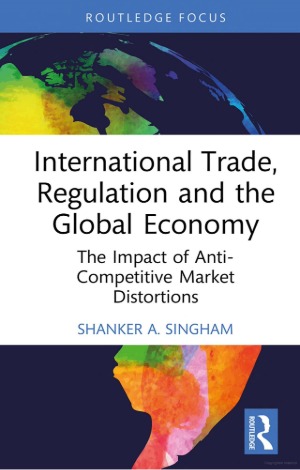
The barriers between the voluntary exchange of willing buyers and willing sellers have progressively been reduced through trade liberalisation, competition and better property rights protection. However, the world has done significantly less well in reducing barriers involving competition and property rights. This book analyses how the economic prosperity which was promised has been undermined by these “Anti-Competitive Market Distortions”, which damage international trade as well as domestic conditions of competition and, ultimately, GDP per capita.
Read More
This book first describes the nature of the Anti-Competitive Market Distortions problem and how it has impacted countries since the 1990s. It also highlights a gap in policymaking, detailing how Anti-Competitive Market Distortions have existed in an ungoverned space in both international trade and competition theory. The book also explores the various models of the impact of Anti-Competitive Market Distortions, including the original econometric model to measure the quantum of distortion – and three new variations on this – as well as an agency-based Model. Finally, drawing on techniques from probabilistic methods and quantum mechanics, the book examines the possibility of a probabilistic model to assess the real impact of Anti-Competitive Market Distortions on GDP per capita growth around the world in a far more dynamic and real-time sense than has been possible thus far.
This book will be invaluable to academics and students of trade, competition and international relations in both the legal and economic disciplines.
Table of Contents
Lists of figures and tables
Foreword by Sir Crawford Falconer
Acknowledgements
Chapter 1: The Implications of Recent Trade History
Chapter 2: The Danger Anti-Competitive Market Distortions Present to the International Economic System
Chapter 3: The Application of a Number of Classical Economic Models to understand the Quantum of Distortion
Chapter 4: Recent Improvements, and Refinements of Singham-Rangan-Bradley model and Introduction to Probabilistic Analysis of the Quantum of Distortion
Chapter 5: Review of Global Growth Trajectory if ACMDs had been properly dealt with
Chapter 6: Some Recommendations to Integrate ACMD Policy into Trade and Economic Policy
Bibliography
Index
Select Reviews
Shanker A. Singham is the top conservative economist of his generation. In his latest book, he explains how market distortions affect trade, domestic regulation and economic growth globally. This new work represents Singham’s most compelling effort to illustrate the scope and depth of regulatory overreach with new metrics. I urge policy makers to use these provocative new insights to drive game-changing impact in their countries’ economies, poverty alleviation, and human flourishing worldwide. The numbers now prove what Singham has long said intuitively – that the upside of restrained and thoughtful regulation is massive, but the cost of getting regulation wrong is—and always has been—catastrophic, leading us into a potentially very dangerous and polarized world.
– Kerry Healey, Former Lt-Governor, Massachusetts and former President, Babson College
This book is not only valuable to students of international trade but is essential reading for trade policy makers around the world.
– Kevin Franklin, former Senior Director HM Revenue and Customs
The U.S. trade system regulating imports is in need of a remedy that is flexible enough to address the wide range of non-market practices in the global economy that damage U.S. firms and workers. Shanker Singham has been ahead of his time in developing this proposal to quantify and redress market distortions that damage trade and competition. This timely book will be highly useful for policymakers who are navigating the challenging trade world we face today. It is a must-read for anyone who worries about declining productivity and economic growth in Western nations and around the world.
– Meredith Broadbent, Former Chairman of International Trade Commission. Former Assistant USTR for Industry, Market Access and Telecommunications
Shanker A. Singham has been the global leader in studying – and measuring – how government-imposed economic market distortions (ACMDs) distort trade, harm competition, and weaken property rights. These effects combine to significantly reduce economic growth around the world.
In addition to authoring pathbreaking studies of ACMDs, he chairs the non-partisan Growth Commission. The Commission is an independent organisation of international economists producing new research and dynamic economic modelling which identifies policies that can increase income per person.
This book represents Singham’s latest and most important effort to establish and refine metrics that estimate the economic harm stemming from ACMDs.
The numbers now prove what Singham has been saying intuitively – eliminating ACMDs has a tremendous economic upside. It spurs economic growth and raises per capita GDP for all citizens.
Public policymakers would do well to take note of Singham’s findings. Future global economic prosperity may depend upon governments’ willingness to root out and tackle ACMDs.
– Alden Abbott, Senior Research Fellow, Mercatus Center at George Mason University, former General Counsel, Federal Trade Commission.
Channeling the 17th-century philosopher Thomas Hobbes, Shanker A. Singham writes, ‘ The normal state of human beings is poverty and war.’ Singham then spends the next 123 pages of his new book on anti-competitive market distortions outlining how countries, by abandoning government-imposed restrictions, can (and should) enhance national prosperity and, ultimately, peace. Singham’s insightful and timely book ought to be required reading for federal policymakers.”
– James Carter, Former Associate Director, National Economic Council, The White House
Written by one of the world’s greatest economic thinkers, this book illustrates the scale of market distortions in the global economy. Shanker A. Singham expertly weaves the scale of distortion into the wider economic and national security picture, precisely describing how the world will be more at risk of conflict and war if these distortions are not dealt with. The world grows more dangerous by the moment, and Shanker A. Singham presents a way out of poverty and war into prosperity and peace. It is a must read.
– John Poindexter, Former National Security Advisor

To Purchase Book
Click Here
or
Scan QR Code

Trade, Competition and Domestic Regulatory Policy presents a unique combination of analysis of both international trade and investment policies, and competition and regulatory policies. Increasingly, policymakers, businesses and the law and economics professions need to better understand how changes and policy developments in international trade and competition developed and how their interaction impacts on global business.
Read More
This book first describes the nature of the Anti-Competitive Market Distortions problem and how it has impacted countries since the 1990s. It also highlights a gap in policymaking, detailing how Anti-Competitive Market Distortions have existed in an ungoverned space in both international trade and competition theory. The book also explores the various models of the impact of Anti-Competitive Market Distortions, including the original econometric model to measure the quantum of distortion – and three new variations on this – as well as an agency-based Model. Finally, drawing on techniques from probabilistic methods and quantum mechanics, the book examines the possibility of a probabilistic model to assess the real impact of Anti-Competitive Market Distortions on GDP per capita growth around the world in a far more dynamic and real-time sense than has been possible thus far.
This book will be invaluable to academics and students of trade, competition and international relations in both the legal and economic disciplines.
Table of Contents
Chapter 1: Purposes of Trade Liberalisation and Competitive Markets
Chapter 2: Introduction to Institutions Underpinning Global Trade and Regulations
Chapter 3: The Role of Consumer Welfare in Competition Implementation and Enforcement
Chapter 4: A Brief Introduction to the Theory of Anti-Competitive Market Distortions
Chapter 5: Trade Policies and Trade Remedies through the Lens of Competition and Consumer Welfare
Chapter 6: The General Agreement on Tariffs and Trade: A Temporary Fix but a Constitutional Foundation
Chapter 7: Trade and Competition in Agriculture: A Trade Negotiation and Sugar Case Study
Chapter 8: State-Trading Enterprises and State-Supported Monopolies: Beginnings of Consumer Welfare Test
Chapter 9: Domestic Regulatory Reform
Chapter 10: The Role of Property Rights in Building a Competitive Market
Chapter 11: Protecting Property Rights: The Triple Interface between Intellectual Property, Competition and Trade
Chapter 12: Trade in Services: General Introduction
Chapter 13: Financial Services
Chapter 14: Impact of the New Media Economy
Chapter 15: Conclusion
Select Reviews
“The authors explain and defend competition law enforcement policies based on the principle of promoting consumer, rather than producer, welfare. They do a good job of noting how certain recent and possible changes could harm innovation and welfare.”
“…another key part of this ambitious book is its discussion of the role of property rights in maximizing consumer welfare and the importance of antitrust and trade rules that lead to the protection of intellectual property rights… Singham and Abbott provide a thorough discussion of the history and reasoning behind the antitrust and trade treatment of intellectual property rights…”
“On the whole, this book offers a comprehensive, thoughtful, integrated treatment of the interrelationship of trade, competition law and intellectual property policy and market distortions that can occur across the three areas. It is an important read for anyone contemplating the challenging issues of trade and economic security in an increasingly complicated and volatile world.” – Review in Concurrences by Deborah Garza, Anti-Trust expert
Click here to read full review.
“It’s a book that you want on your bookshelf. To bring together international trade, domestic economic regulatory policy and patent rights is so important today when we are trying to figure out how to get along with a lot of other different countries with different ways of doing things. This book brings us back to the basics.” –Christine McDaniel, International Trade and Property Rights Expert
Launch Events


To Purchase Book
Click Here
or
Scan QR Code

Drawing on a range of global case studies, Market Distortions in Privatisation Processes illustrates the ways in which market distortions damaged the ability of privatisation processes to yield concrete benefits to consumers.
Read More
The book compares and contrasts privatisations of state-owned enterprises around the world where competition informed the regulatory design and thus liberated consumer welfare. In particular, the cases are drawn from the electricity and gas sector, the telecoms industry, and postal services – each of which has been frequently privatised in different context. For each industry, the book explores the UK and US experiences as well as looking at international cases from both developed and developing countries including, where appropriate, Japan, Colombia, Romania and Mexico. The emphasis is on analysing the impact that market distortions have had on the outcomes of those privatisations. The book also looks at how public service objectives were achieved and how they too can be designed in pro-competitive or anti-competitive ways.
This book will be of significant interest to readers in international business, economics, and law.
Table of Contents
Chapter 1: Impact of Market Distortions in The Specific Case of Privatisation
Chapter 2: Competition and Regulated Industries: Electricity and Gas
Chapter 3: Competition and Regulated Industries: Telecommunications
Chapter 4: Postal Services
Chapter 5: Conclusion

To Purchase Book
Click Here
or
Scan QR Code

Read More
1905017421